A
The first Irish letter is A (pronounced “ah”) compared to the English A (“ay”).
Like all Irish vowels, there are two forms of A: short A (A) and long A (Á).
The long A (Á) is marked with a fada (´), giving Á.
Both Irish As are single (pure) vowel sounds, unlike the gliding English sound of “ay” (say, hay).
We’ll practice the sounds step-by-step, so you can recognize and pronounce A correctly in Irish.
Learn

The Two As
The short A (A) is a front vowel, an “ah” sound you make by keeping your:
- Mouth. Fully open.
- Tongue. Flat to floor of mouth and pushed towards the front teeth.
- Lips. Unrounded / flat, like a slight smile.
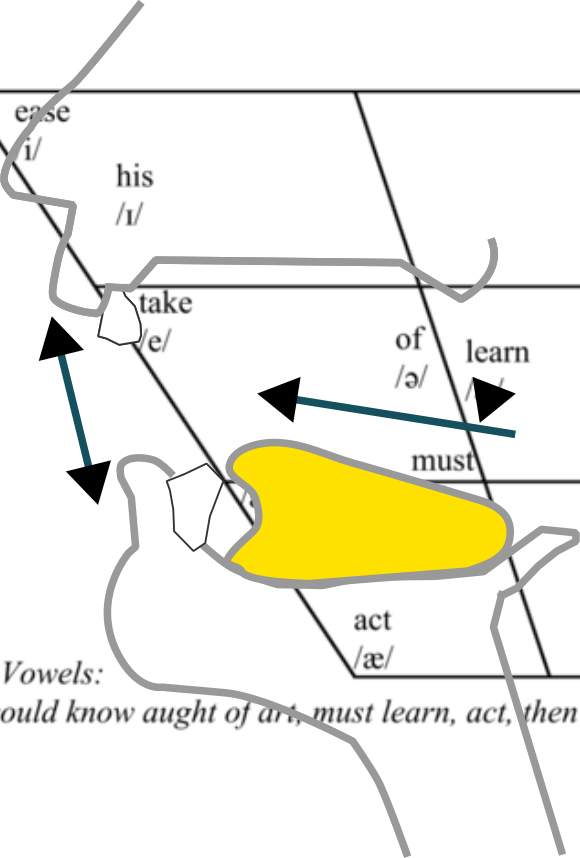 Front
Front
The pronunciation of short A (A) is written as [aː] in the International Phonetic Alphabet (IPA). It is an open, unrounded vowel sound, and the triangular colon (ː) means it is held a little when sounded. The vowel in English ship is [i], while the vowel in sheep is [iː], for example.
The long A (Á) is a back vowel [ɑː] that you make by keeping your:
- Mouth. Open, same amount as short A (A).
- Tongue. Flat to floor of mouth but pulled back towards the throat.
- Lips. Unrounded / flat, same as short A (A).
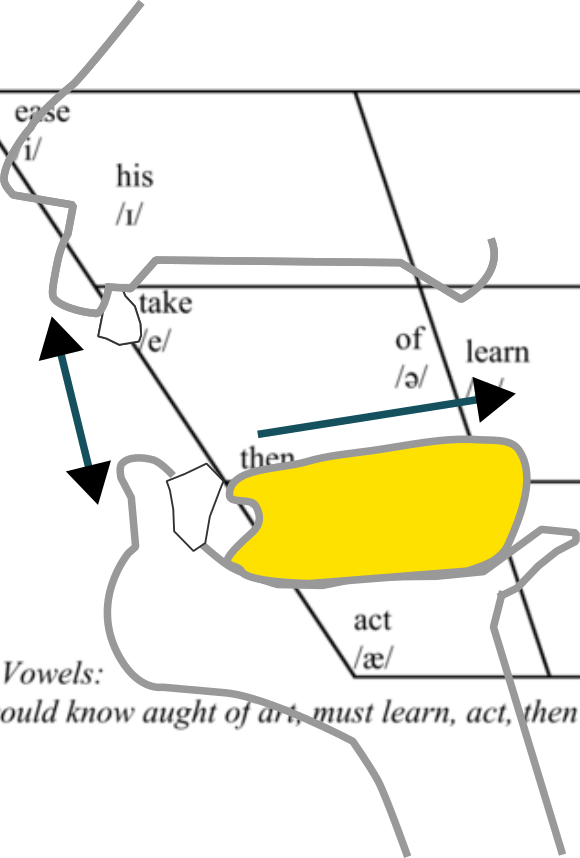 Back
Back
You’ll hear the difference clearly in the audio:
The long A (Á) is always pronounced the same, no matter where it is in a word.
It is much more complicated for short A (A), but there are consistent patterns we can learn.
Start of a Word
The short A (A) has several possible pronunciations depending on what letters follow it, but there are consistent patterns.
It can be pronounced in its standard form as [aː] (“aah”).
You can hear this in the word ard (high, tall):
Many words will have the standard [aː] sound, but there are important exceptions.
-
abh- becomes a glide between two vowel sounds (diphthong ), [au], like the “ow” in English how. Notice how your mouth moves when saying “ow”, rather than staying steady like a pure vowel sound (monophthong ).
The Irish word abhainn (river) has this change:
-
amh- becomes a long, mid-back rounded vowel [oː], like the first “o” in the name of the town of Oranmore.
You can hear this in the Irish word amhrán (song):
-
adh- or agh-, become a glide between two vowel sounds, [ai], pronounced like “eye”.
You can hear this in the Irish word aghaidh (face), which sounds much like the English eye:
-
But, if the adh- / agh- is followed by a “heavy” sounding consonant like M, then the short A (A) is sounded like a long A (Á), [ɑː].
You can hear this change in the Irish word adhmad (wood, timber):
Before certain letters (ll, m, nn ) the short A (A) is sounded like a long A (Á):
-
The Irish word am (time) is a perfect example, where you can hear the “awh” quality of the short A (A).
The stress at the start of a word also has a huge effect—if the A is not stressed, it becomes “reduced” (shorter/weaker):
-
The A in ag (at) is a quick, lazy “eh” called schwa (ə).
The same pattern applies to words like anseo (here), ansin (then) and anois (now), where you barely hear a vowel before the first N.
-
While the A in ar (on) is a quick, mid-open front vowel (ɛ).
Middle of a Word
If short A (A) is neither at the start nor the end of a word, we say it is “in the middle”.
And there are a few possible pronunciations:
-
Short A. In its standard form, [aː], if the syllable is stressed.
-
Schwa. If the syllable is not stressed, then it is a schwa, like the a in China. We’ll cover this below.
-
Silent. The “a” is silent in buidéal (“bottle”) being used to mark the “l” as broad.
How will you know which is which?
Practice! But usually any short A (A) that is not in the first syllable is a schwa.
End of a Word
At the end of a word, short A (A) is not pronounced like the full “ah”.
This is a common mistake, but very easy to fix.
A short A (A) at the end of a word is a quick, lazy “ah” called schwa (ə), a technical term for a neutral mid-vowel.
- Mouth. Open (one finger width).
- Tongue. Neutral position in center of mouth.
- Lips. Unrounded / flat, like a slight smile.
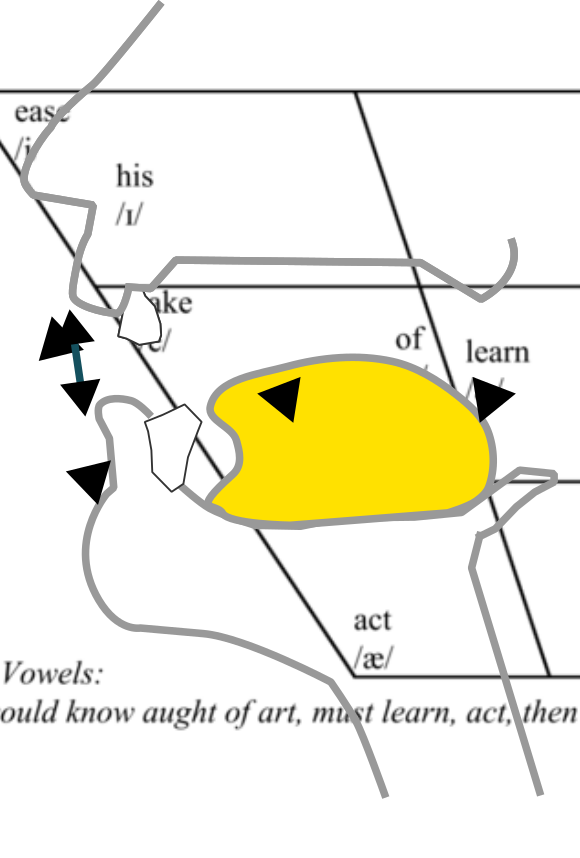
The schwa is the most common vowel in English, like the “a” in China.
The short A (A) in the Irish word mála (“bag”) should sound like the “a” in China:
- it should NOT be pronounced with a strong “AH” sound, i.e. “maw-LAH”. ❌︎